
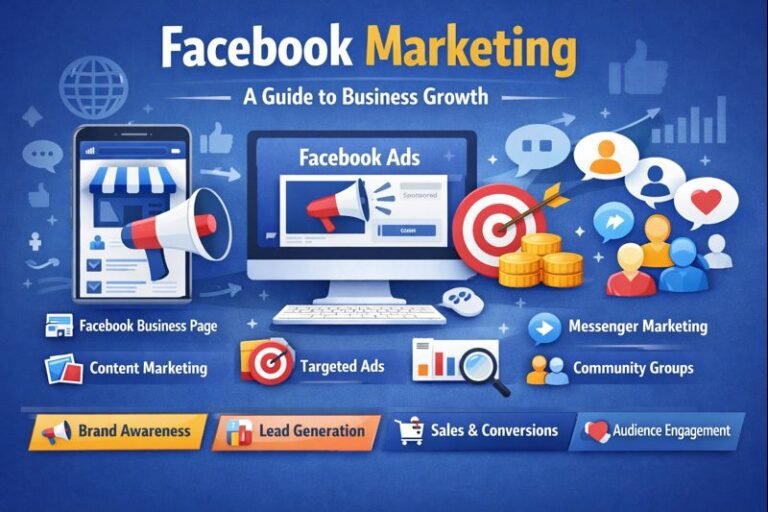
In today’s digital landscape, Facebook marketing has become one of the most powerful tools for businesses to reach, engage, and convert their target audience. With billions of active users worldwide, Facebook offers unmatched opportunities for brand visibility, customer interaction, and sales growth.
This blog explains what Facebook marketing is, why it matters, and how businesses can use it effectively to achieve measurable results.
This involves posting free content on a Facebook Business Page, such as educational posts, promotional updates, images, videos, and reels. Organic marketing focuses on long-term brand building and engagement.
Paid marketing allows businesses to reach a larger and more targeted audience instantly. Ads are ideal for lead generation, sales, app installs, and website traffic.
Messenger marketing enables direct communication with customers through automated replies, chatbots, and personalized messages, improving customer support and conversions.
Facebook Groups help businesses create communities around their brand, encouraging discussions, loyalty, and long-term engagement.
Facebook Ads operate through Meta Ads Manager, where businesses create campaigns based on specific objectives.
Common objectives include:
Brand Awareness
Traffic
Engagement
Lead Generation
Sales and Conversions
Facebook allows precise targeting through:
Core audiences (demographics and interests)
Custom audiences (website visitors, email lists)
Lookalike audiences (similar to existing customers)
Popular Facebook ad formats include:
Image Ads
Video Ads
Carousel Ads
Collection Ads
Reel Ads
Below is a clear, professional comparison table commonly used in informative blogs on Facebook Marketing. It compares Organic Facebook Marketing vs Paid Facebook Marketing, which is highly relevant for readers and SEO content.
| Aspect | Organic Facebook Marketing | Paid Facebook Marketing (Facebook Ads) |
|---|---|---|
| Definition | Free promotion using regular posts on a Facebook Page | Paid promotion using Meta Ads Manager |
| Cost | No direct cost | Requires advertising budget |
| Reach | Limited to existing followers and algorithm visibility | Wide and scalable reach |
| Audience Targeting | Very limited targeting options | Advanced targeting (age, location, interests, behavior) |
| Speed of Results | Slow and long-term | Fast and immediate |
| Best For | Brand awareness and community building | Lead generation, sales, and conversions |
| Content Types | Posts, images, videos, reels, stories | Image ads, video ads, carousel, reels ads |
| Control Over Visibility | Low | High |
| Measurability | Basic insights | Detailed analytics and performance tracking |
| Scalability | Difficult to scale | Easy to scale with budget |
| ROI Tracking | Limited | Highly measurable and optimized |
| Ideal Users | Small businesses, startups, personal brands | Growing businesses, marketers, agencies |
Organic Facebook marketing focuses on long-term engagement and trust, while paid Facebook marketing delivers quick, targeted, and measurable results. A successful Facebook marketing strategy combines both approaches for sustainable business growth.
If you want, I can also provide:
Facebook vs Instagram Marketing comparison
Facebook Ads vs Google Ads comparison
Beginner vs Advanced Facebook Marketing strategy table
A downloadable table format for websites or PDFs
Advertisers can choose daily or lifetime budgets and optimize bidding for results such as clicks, impressions, or conversions.
A successful Facebook marketing strategy begins with creating and optimizing a professional Facebook Business Page. Your page should include a high-quality logo, an engaging cover image, complete business information, and a clear call-to-action button that guides users toward your desired outcome. Once your page is set up, the next step is to define your target audience. Understanding your ideal customer’s demographics, interests, online behavior, and pain points allows you to create relevant content and highly targeted advertisements that resonate with the right people.
After identifying your audience, focus on planning high-quality content that delivers value. An effective content strategy includes a balanced mix of educational posts, promotional updates, and engagement-driven content such as polls or videos. Consistency in posting and maintaining content quality are critical to building trust and long-term engagement. To accelerate results, businesses should then launch paid ad campaigns with clear objectives, such as traffic, lead generation, or sales. Testing different ad creatives, formats, and audience segments helps identify what performs best, allowing you to gradually scale successful campaigns.
Monitoring and analyzing performance is the final and ongoing step in the strategy. By tracking key metrics such as reach, engagement, click-through rate, conversions, and cost per result, businesses can make data-driven decisions and continuously optimize their Facebook marketing efforts for better returns.
Following best practices ensures consistent and sustainable results in Facebook marketing. Maintaining uniform branding across all posts and advertisements helps strengthen brand identity and recognition. High-quality visuals paired with clear and concise messaging improve engagement and conversion rates. Regular A/B testing of ad creatives, audiences, and copy enables marketers to refine performance over time. It is also essential to focus on value-driven content rather than excessive promotion, as informative and helpful posts build trust. Promptly responding to comments and messages further enhances customer relationships and brand credibility.
Many businesses fail to achieve results due to common Facebook marketing mistakes. Targeting overly broad or irrelevant audiences often leads to wasted ad spend and poor performance. Posting inconsistently or without a structured content plan reduces visibility and engagement. Ignoring analytics and performance data prevents marketers from identifying what works and what needs improvement. Using low-quality visuals or unclear ad copy can negatively impact brand perception, while expecting instant results without proper testing and optimization often leads to disappointment.
The future of Facebook marketing is shaped by rapid technological advancements and evolving user behavior. AI-powered ad optimization is improving targeting accuracy and campaign efficiency. Video content, especially reels, is becoming increasingly dominant as users prefer short, engaging formats. Automation through chatbots and smart campaigns is enhancing customer interaction and operational efficiency. Additionally, personalized and data-driven marketing strategies are enabling businesses to deliver more relevant experiences, helping them gain a competitive advantage in the digital marketplace.
Facebook marketing is no longer optional; it is a vital component of a successful digital marketing strategy. By combining organic content, paid advertising, and continuous data-driven optimization, businesses can reach the right audience, build strong relationships, and achieve long-term growth. A strategic, consistent, and professional approach to Facebook marketing ensures sustainable success in an ever-changing digital landscape.
Aajubaju Digital is an award-winning digital marketing firm with more than 15 years in SEO and Web Design. We specialize in growing businesses and websites online by bringing our clients more traffic, more calls, and more sales.